
Hair Guide
Harmful Ingredients in Shampoo for Teens: 7 to Avoid

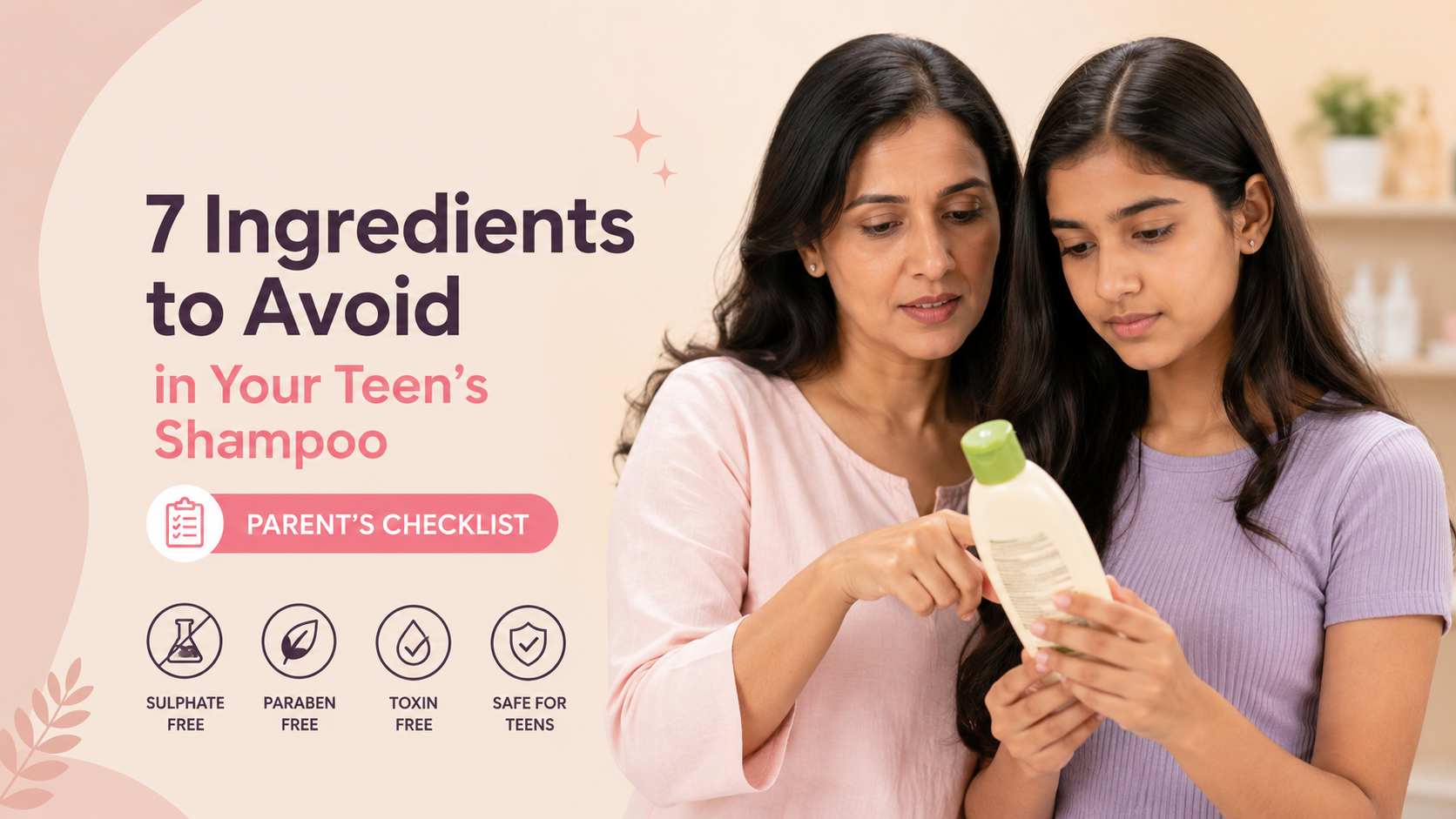
Harmful Ingredients in Shampoo for Teens: 7 to Avoid
Choosing a shampoo for a teenager can feel simple—until you read the ingredient label. The goal is not to fear every chemical, but to understand which ingredients may be unnecessary or more likely to cause dryness, buildup or irritation for some teens. This parent’s checklist explains harmful ingredients in shampoo for teens and what to look for instead.
Why Should Parents Check Shampoo Ingredients?
Teen hair and scalp can change with puberty, sweat, sports, pollution, oiliness and frequent washing. A formula that is too harsh may leave the scalp tight while hair feels dry or rough. “Chemical-free” is also not a meaningful standard because everything in a shampoo is made of chemicals. A better approach is to choose a well-formulated product and understand the ingredients you may prefer to avoid.
7 Shampoo Ingredients Parents Should Check Carefully
1. Sulfates: SLS and SLES
Sodium lauryl sulfate (SLS) and sodium laureth sulfate (SLES) are cleansing agents that create foam and remove oil. They are not automatically unsafe, but some teens with dry or sensitive scalps may find strong cleansing formulas uncomfortable. If hair feels stripped after washing, consider a sulfate-free shampoo with milder cleansing agents.
2. Parabens
Methylparaben, propylparaben, butylparaben and ethylparaben are preservatives that help prevent microbial growth. The FDA says parabens have not been shown to be harmful as used in cosmetics. Parents who prefer paraben-free formulas can identify these names on labels. “Paraben-free” is a preference, not proof that every product containing parabens is dangerous.
3. Formaldehyde-Releasing Preservatives
Some preservatives can release small amounts of formaldehyde over time. Examples include DMDM hydantoin, imidazolidinyl urea and diazolidinyl urea. Families who prefer to avoid these ingredients should scan the label carefully, particularly for sensitive scalps.
4. Added Fragrance
“Fragrance” or “parfum” can represent a mixture of ingredients. Fragrance is not automatically harmful, but some people are sensitive or allergic to fragrance components. For parents reviewing harmful ingredients in shampoo for teens, fragrance is worth checking if a child develops itching, redness or irritation. A fragrance-free option may be worth trying.
5. Phthalates
Phthalates can be used in fragrance formulations, although their use in cosmetics has decreased. The FDA notes that diethyl phthalate (DEP) is still used in some cosmetics and does not identify a safety concern with DEP as currently used in cosmetics. If you want to minimize exposure, choose products that do not list “fragrance” or “parfum,” while remembering this does not prove every fragranced product contains phthalates.
6. Harsh or Drying Alcohols
Not every ingredient with “alcohol” in its name is bad. Fatty alcohols such as cetyl alcohol and stearyl alcohol can help condition hair. Short-chain alcohols such as alcohol denat., ethanol or SD alcohol may feel drying for some hair types. If your teen has dry or frizzy hair, choose a formula that balances cleansing with conditioning.
7. Certain Silicones When Buildup Is a Concern
Silicones such as dimethicone can smooth hair, reduce friction and improve shine. They are not inherently harmful. However, some heavier silicones may contribute to buildup for certain hair types. If hair feels coated or limp, consider a lighter formula or an occasional clarifying wash.
What to Look for Instead
Rather than focusing only on harmful ingredients in shampoo for teens, look for a balanced formula suited to your teen’s scalp and hair type:
- Mild cleansing agents such as cocamidopropyl betaine, sodium lauroyl sarcosinate or decyl glucoside.
- A pH-balanced formula designed to be gentle on hair and scalp.
- Conditioning ingredients such as aloe vera, argan oil, coconut oil or hydrolyzed proteins, depending on hair needs.
- A clear ingredient list and transparent labeling.
- Targeted formulas for oiliness, dryness, dandruff or frizz.
Parents searching for a sulphate paraben free shampoo in India can start by checking the complete ingredient list rather than relying only on claims printed on the front of the bottle.
Parent’s Label-Reading Checklist
When checking for harmful ingredients in shampoo for teens, read the ingredient list rather than relying only on front-label claims. Check for known sensitivities and do not assume that “natural,” “organic,” “chemical-free” or “hypoallergenic” automatically means better.
If your teen develops persistent itching, redness, swelling, severe dandruff or another scalp problem, stop using the suspected product and speak with a dermatologist.
The Bottom Line
Understanding harmful ingredients in shampoo for teens does not mean avoiding every synthetic ingredient. It means choosing products thoughtfully and matching them to your teen’s scalp and hair needs.
The best approach to harmful ingredients in shampoo for teens is simple: read the label, understand what your teen needs and choose a shampoo and conditioner with a well-balanced formula. Good teen hair care should cleanse without leaving the scalp uncomfortable and condition without unnecessary heaviness.