
Hair Guide
7 Shampoo Ingredients to Avoid in Your Teen’s Shampoo & Conditioner (Parent’s Checklist)

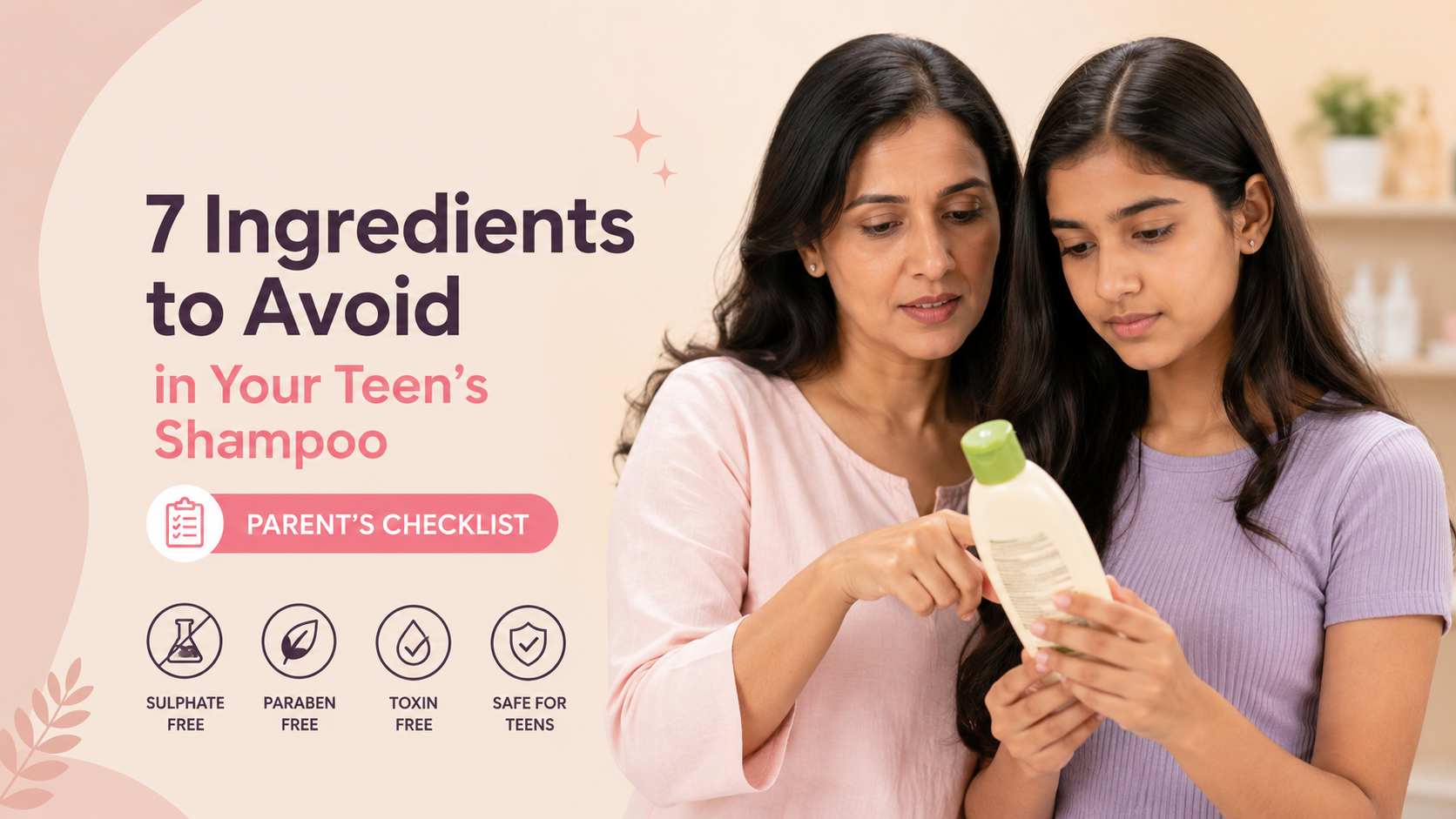
Puberty brings plenty of changes—and your teen’s hair is no exception.
One month they may complain about oily roots, the next it’s dry ends, frizz, or dandruff. While it’s tempting to buy products that promise instant results, the truth is that many adult shampoos contain ingredients that can be unnecessarily harsh for developing hair and sensitive scalps.
Understanding the harmful ingredients in shampoo for teens doesn’t mean fearing every chemical on the label. Instead, it means knowing which ingredients are worth avoiding and choosing products that support healthy hair rather than masking problems.
Here’s a simple checklist every parent can use before buying the next shampoo or conditioner.
✔️ 1. Harsh Sulphates (SLS & SLES)
Sulphates are cleansing agents responsible for creating rich foam.
The most common ones include:
- Sodium Lauryl Sulphate (SLS)
- Sodium Laureth Sulphate (SLES)
Although they clean effectively, they can strip away the scalp’s natural oils.
For teenagers whose oil production is already changing because of hormones, excessive cleansing can lead to:
- Dry scalp
- Frizzy hair
- Increased breakage
- Irritation for sensitive skin
If your teen has curly, coloured, or dry hair, choosing a sulphate paraben free shampoo India parents trust can be a gentler option.
✔️ 2. Parabens
Parabens are preservatives used to increase shelf life.
Common names include:
- Methylparaben
- Propylparaben
- Butylparaben
Although regulatory authorities allow their use within safe limits, many parents prefer paraben-free products because there are effective alternative preservatives available today.
When shopping, selecting shampoos labelled as safe shampoo ingredients teenagers can simplify your decision.
✔️ 3. Harsh Drying AlcoholsNot every alcohol is bad.
Fatty alcohols such as Cetyl Alcohol and Stearyl Alcohol actually moisturise hair.
The ones worth limiting are:
- Alcohol Denat.
- Isopropyl Alcohol
- SD Alcohol
These evaporate quickly and may leave hair feeling rough and dehydrated—especially if your teen already uses styling tools.
✔️ 4. Heavy Non-Water-Soluble Silicones
Silicones make hair feel smooth and shiny.
However, some heavy silicones build up over time and require stronger shampoos to remove.
Examples include:
- Dimethicone
- Amodimethicone (depending on formulation)
- Trimethicone
For teens who shampoo only two or three times a week, this buildup can make hair appear greasy and lifeless.
Water-soluble or lightweight conditioning agents are often a better choice.
✔️ 5. Artificial Fragrance Overload
“Fragrance” or “Parfum” on the label can represent dozens of ingredients.
Strong fragrances aren’t automatically harmful, but heavily scented formulas may trigger irritation in teenagers with:
- Sensitive scalp
- Eczema
- Allergies
Choosing lightly scented or naturally fragranced products is often a safer option for daily use.
✔️ 6. Formaldehyde-Releasing Preservatives
Some preservatives slowly release tiny amounts of formaldehyde to prevent microbial growth.
Common examples include:
- DMDM Hydantoin
- Diazolidinyl Urea
- Imidazolidinyl Urea
Although approved for cosmetic use within regulated limits in many countries, parents who prefer minimalist formulations often choose products without these preservatives.
✔️ 7. Excessive Artificial Colours
Bright colours may make products look attractive, but they offer no haircare benefit.
Artificial colourants can occasionally irritate sensitive scalps.
For everyday teen haircare, simpler formulations with fewer unnecessary additives are usually a better choice.
What Should Parents Look For Instead?
Rather than focusing only on avoiding certain ingredients, it’s equally important to know what makes a shampoo suitable for teenagers.
Look for products that are:
✔ Mild cleansing formulas
✔ pH balanced
✔ Sulphate-free or low-sulphate cleansers
✔ Paraben-free (if preferred)
✔ Enriched with gentle conditioning ingredients
✔ Dermatologically tested
✔ Suitable for regular use
✔ Free from unnecessarily harsh additives
These features help maintain the scalp’s natural barrier while keeping hair clean and manageable.
A Quick Parent’s Shampoo Label Checklist
Before adding a shampoo to your cart, ask yourself:
✅ Is it designed for growing hair?
✅ Is it gentle enough for frequent washing?
✅ Does it avoid unnecessarily harsh sulphates?
✅ Is it suitable for sensitive scalps?
✅ Does it contain nourishing ingredients?
✅ Is the ingredient list simple and transparent?
If you answer “yes” to most of these questions, you’re probably making a better choice than simply buying the strongest “repair” shampoo on the shelf.
Remember: “Chemical-Free” Doesn’t Really Exist
Many parents search for chemical free hair products India, but it’s worth knowing that everything—including water and plant extracts—is made of chemicals.
Instead of looking for “chemical-free,” focus on products that use safe, well-formulated ingredients appropriate for teenage hair and scalp. Marketing claims can be misleading, while reading the ingredient list gives you a much clearer picture of what you’re buying.
Final Thoughts
Teenage hair doesn’t need dozens of specialised products or harsh cleansing formulas. In most cases, a gentle, balanced shampoo and conditioner with safe shampoo ingredients for teenagers is enough to support healthy hair through the changing years of puberty.
By understanding the harmful ingredients in shampoo for teens and knowing what to look for instead, parents can confidently choose products that cleanse effectively without compromising the scalp’s natural balance.
A simple, consistent haircare routine with mild, thoughtfully formulated products often delivers better long-term results than chasing trendy ingredients or exaggerated marketing claims. have to know what to look for on the back of the bottle, not just the front.